Friday, 9 November 2018

Food out of the Temperature Danger Zone

Bacteria grow most rapidly in the range of temperatures between 40 °F and 140 °F, doubling in number in as little as 20 minutes. This range of temperatures is often called the "Danger Zone." Never leave food out of refrigeration over 2 hours.

More details click here.


RISK FACTORS & REPERCUSSIONS

A risk assessment is a systematic appears at your place of work to recognize those things, situations, processes, etc. that might cause damage, mainly to people. After recognition is complete you examine and appraise how possible and severe the risk is. When this purpose is made, you can next, choose what actions should be in place to effectively eliminate or manage the damage from occurring.

Read More

The benefits to integrating management systems

The  Integrated Management Systems benefits ofyour organization through increased efficiency and effective, and cost reduction while minimizing the disruption caused by several external audit. Risks & Opportunity for Product & Service. Customer Requirements & Satisfaction. Environmental Impact. Health & Safety Hazards.

Read More for IMS Click Here...


Thursday, 8 November 2018

The Benefits of Nebosh Courses for Employers

Commitment to health and safety shows that the candidate can help the organization to achieve, maintain and operates according to recognized standards like ISO andmuch more.

When the industry works to health and safety of international standards,the environment is a pre-requisite while trying to winning new business. Around 90% of organization demands for any one of the NEBOSH qualification, which show the recognition and value of NEBOSH qualifications.

LockOut TagOut Safety Tips

The lockout is distinct as the “position of a lock or tag on an energy isolating machine in accord with a well-known process, inset to the energy-isolating machine is not toward existing operated until taking away of the lock or tag in accord with a recognized process”.

Tag out is a labeling procedure that is forever used when the lockout is essential.The procedure of tagging out a system involves attaching or by an indicator (usuallya standardized label).

Read More....

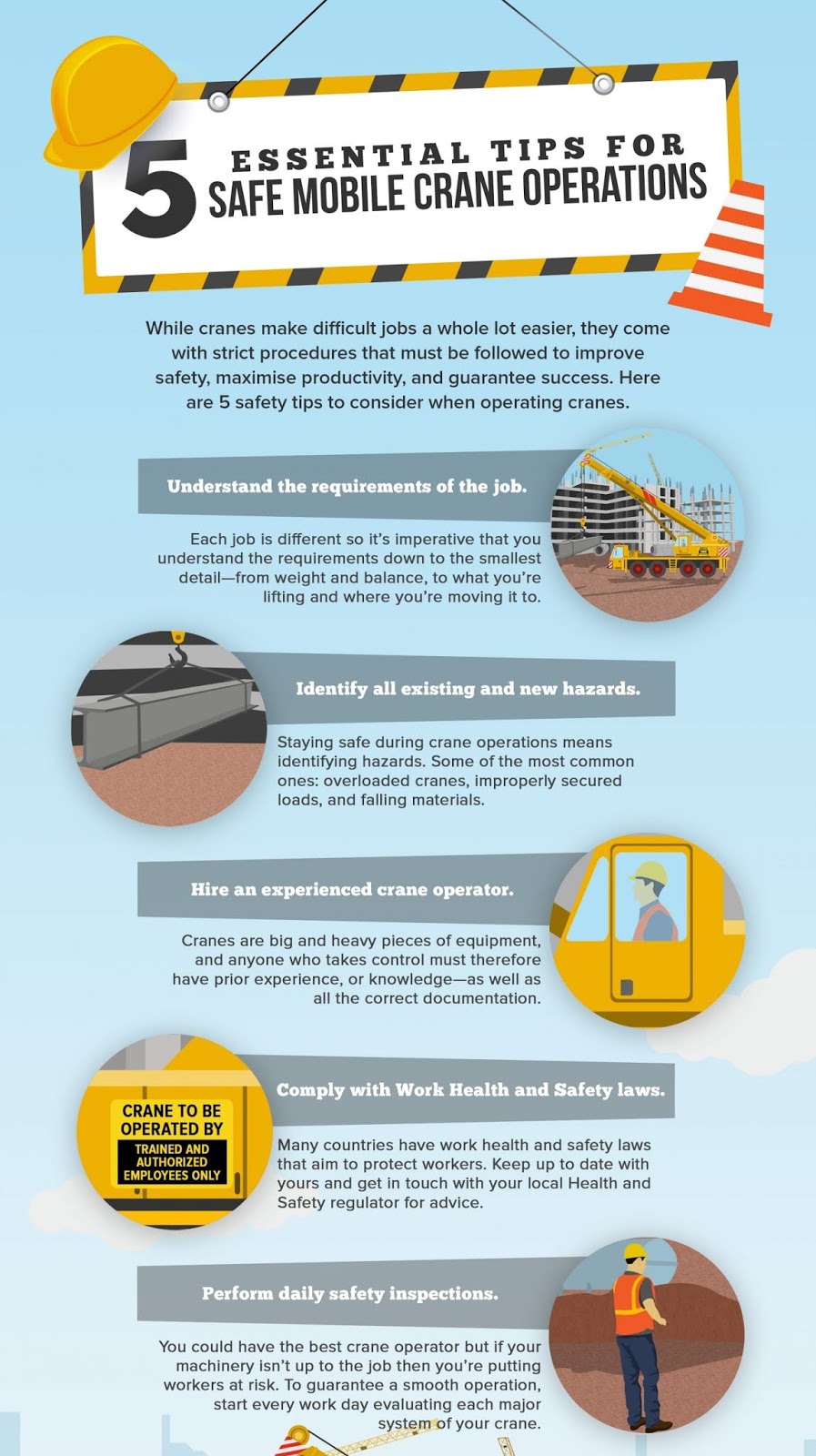
5 Essential Tips For Mobile Crane Safety Operation

While cranes make difficult jobs a whole lot easier, they come with strict procedures that must be followed to improve safety, maximise productivity, and guarantee success.

Understand the requirements of the job: 

Each job is different so it's imperative that you understand the requirements down to the smallest detail—from weight and balance, to what you're lifting and where you're moving it to.

Identify all existing and new hazards: 

Staying safe during crane operations means identifying hazards. Some of the most common ones: overloaded cranes, improperly secured loads, and falling materials.

Hire an experienced crane operator: 

Cranes are big and heavy pieces of equipment, and anyone who takes control must therefore have prior experience, or knowledge—as well as all the correct documentation.

Comply with Health and safety laws:

Many countries have work health and safety laws that aim to protect workers. Keep up to date with yours and get in touch with your local Health and Safety regulator for advice.

Perform daily safety inspections:

You could have the best crane operator but if your machinery isn't up to the job then you're putting workers at risk. To guarantee a smooth operation, start every work day evaluating each major system of your crane.
See Also: Rospa Approved Lifting Operation Training | NEBOSH Training Course

We also Provide Safety Diploma courses, Nebosh IGC and Nebosh IDIP, IRCA 45001:2018, Nebosh PSM and Many more..

OUR INTERNATIONAL PRESENCE : Nebosh in Saudi Arabia | Nebosh in Dubai

Saturday, 3 November 2018

How to Become an HSE Expert with a Diploma in Industrial Safety

Industrial safety is a division of management which deals with the study of prevention of some accident or danger, associated to the health of the employees or equipments, chemicals or machines used in an industry.

The aim of Industrial Safety Management is to reduce the possibility of risks, accidents and injuries by the implementation of varied techniques of risk and safety management. Safety management experts develop and execute various precautionary procedures to keep a safe work environment.

For Enquiry Click Here...